
This guide comes from Home Pros (Balint Holdings, LLC), a veteran-owned cash buyer in San Antonio that runs novation sales with wholesalers and agents. It sits in our novation guide hub. We read the Texas Occupations Code, the Texas Real Estate Commission's 88th session summary, Wisconsin Statute 710.13 and the Oklahoma Real Estate Commission's wholesaling guide on November 14, 2026, and each legal line below links to the page it came from.
Not legal advice. These are plain-language readings of the statutes and commission pages cited. Have a real estate attorney in your state review your contract and disclosure forms before you use any script here.
What do you say when your cash number won't work?
You tell the truth first. Most novation pitches die because the wholesaler hid the ball on the first call, then tried to switch structures on the second. Sellers smell that. So the pivot starts with an admission:
"I ran this three ways and I can't get to your number with cash. If I wrote it up, I'd be guessing low and you'd be right to turn me down. There's another way we sell houses like yours, though. Can I take two minutes to walk you through it?"
That line does three jobs. It respects the seller's number. It tells them you did the math instead of throwing out a lowball. And it asks permission, which matters more than any word that follows.
Don't say "creative financing." Don't say "I have a special program." Those phrases make people reach for their guard. Say what's true: the house is worth more on the open market than a cash investor can pay, and there's a way to sell it there without the seller paying for repairs or commissions.
If they say no, you're done. Thank them and leave your number. A seller who wanted a fast cash close at retail price doesn't exist, and a seller who wanted retail with no time cost doesn't either. Your job on this call is to find out which one is real. We'd rather lose a pitch than talk someone into the wrong structure, because a seller who feels tricked at week five cancels at week six.
How do you explain a novation in one breath?
Use the cash offer as the anchor. The seller already understands what a cash buyer does, so describe the novation as the same deal with the expensive middle cut out. Trevor Rice, our head of acquisitions, puts it close to this on calls:
"It's just like a cash offer. The difference is, instead of us buying it with a lender, paying closing costs, fixing it up and paying closing costs again on the way out, we sell it with you while we're under contract. We skip those costs, and the savings go into your number."
Then give them the road. Five stops, every time, in the same order:
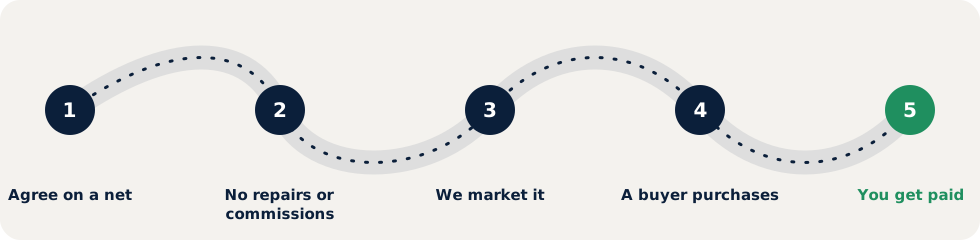
Agree on a net price. No repairs or commissions on the seller's side, and we cover closing costs. We market the house. A buyer purchases. The seller's paid the agreed net at closing. That's it.
Stop talking after the roadmap. Seriously. Let them ask the next question, because whatever they ask first is the objection you'll need to handle. If it's "how long," they're worried about time. If it's "what's the catch," it's trust. If it's "what do I sign," they're already halfway in.
What does the law make you disclose before the seller signs?
More than most scripts on the internet admit. Three of the states we buy in have written rules for anyone who holds a purchase contract and plans to profit from it without closing first. Whether your novation agreement triggers them depends on how it's drafted, especially whether it lets you assign. Draft as if it does.
| State | Who it covers | What must be disclosed, and when | If you skip it |
|---|---|---|---|
| Texas | A person who assigns or offers to assign an interest in a contract to buy real property | The nature of the equitable interest, in writing, to any seller or potential buyer (Tex. Occ. Code 1101.0045(a)(2)) | The person "is engaging in real estate brokerage" (1101.0045(b)) |
| Wisconsin | A "real property wholesaler": a buyer who intends to assign its rights for consideration, on 1 to 4 unit homes | Written notice to the seller, no later than entering the purchase agreement (Wis. Stat. 710.13(2)(a)) | Seller may rescind any time before closing and keep deposits; the right can't be waived (710.13(3), (4)) |
| Oklahoma | Wholesalers, licensed or not, who contract to assign or resell an equitable interest for profit | Before any contract: written intent to assign or resell for more than the homeowner is offered, a legal-advice notice, and a two-business-day cancellation right with the OREC form (59 O.S. 858-314) | Homeowner may cancel at any time if the disclosures were missing (OREC guide, citing 858-314(F)) |
The Texas Real Estate Commission's own summary is blunt: a wholesaler who doesn't give notice "is engaged in unlicensed brokerage activity," and SB 1577 requires "the same written notice be given to the seller" (TREC). Oklahoma goes further and dictates the warning language next to the seller's signature line.
Our opinion: a disclosure you say out loud on the first call is worth more than the one in the packet. Read the form with them.
What are the word-for-word disclosure lines?
Three facts go on the table before the seller signs anything: who the partner is, what the seller pays, and what the extra document does. Here's how we'd say each one.
The partner.
"I'm going to be straight about who's involved. I bring the deal, and I work with Home Pros, who runs the listing with a licensed agent. We split what's left after your net, closing costs and commissions. You'll see that in writing before the house is listed."
The fee.
"There's one fee on your side: a $500 transaction coordination fee, paid out of your proceeds at closing. Nothing out of pocket now. No commission on your side."
The extra document.
"You'll sign one thing a normal cash sale doesn't have: a limited authorization to sign listing documents, so our partner agent can put the house on the MLS. You stay the owner until closing. If you want your own attorney to read it first, we'll wait."
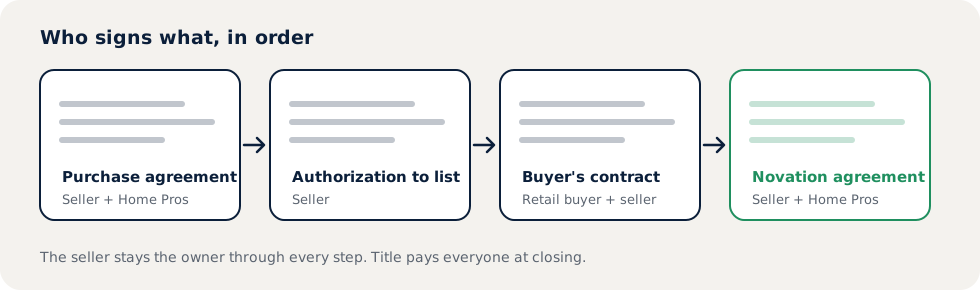
Notice what's missing. There's no line where you blur the authorization into "just standard paperwork." It isn't standard, and calling it that is the fastest way to lose a seller to a cousin who sells real estate. The transaction coordination fee page explains what that $500 covers, so send them the link instead of improvising.
How do you handle the objections sellers raise?
You'll hear the same five, in roughly this order of frequency. Prepare the answer, keep it short, and don't argue past the second exchange.
| What the seller says | What they mean | What you say |
|---|---|---|
| "Why can't you just buy it?" | Is this a bait and switch? | "I can, at my cash number. You told me that's too low, so I'm showing you the route that gets closer to yours. The cash number stays on the table." |
| "How long will this take?" | Can I plan my move? | "Longer than cash, because a retail buyer needs a loan and an appraisal. We'll agree on a date in writing for when we pull the listing if it hasn't sold." |
| "What if it doesn't sell?" | Am I stuck? | "Then we talk about the cash offer again, or we part ways under the terms you signed. Read that clause with me now." |
| "Isn't this just a listing?" | Why not call my own agent? | "You could. With an agent you pay for repairs, a commission and your own closing costs. Here you pick a net and those come out of our side." |
| "Who gets paid what?" | Are you hiding your cut? | "Your net is fixed. Above it come closing costs, commissions and any make-ready, then our split. I'll show you every line." |
The last one is the test. If you flinch, the deal's over, and it should be. A seller who asks about your cut is a seller who'll read the settlement statement, and you want that seller. They don't sue.
On "how long": never promise a closing date you don't control. Say what you control, which is the date you'll stop marketing and hand them the cash option or a release.
One more habit worth building. Write down the objection the seller raised, word for word, in your CRM notes before you hang up. When you call back with paperwork, open by answering that exact worry again. "Last time you asked what happens if it doesn't sell. Here's the clause." Sellers remember who listened, and it's usually the person who repeated their question back to them.
How do you show the seller the numbers?
Put both offers on one page. Sellers decide with their eyes, not their ears, and a side-by-side kills more suspicion than ten minutes of talk. The left column is the cash offer you already ran. The right column starts from a realistic retail price and subtracts the costs a novation still carries.

Here's an illustration with round, made-up numbers so you can see the shape. It's not a deal we closed.
| Line (illustration only) | Cash offer | Novation |
|---|---|---|
| Sale price | $180,000 (investor buys) | $250,000 (retail buyer) |
| Buyer's agent commission and closing costs | Paid by investor | Paid from sale, not by seller |
| Make-ready | None for seller | Paint and cleanup, paid on our side as agreed |
| Seller's fee | None | $500 transaction coordination fee |
| Seller nets | $180,000 less payoff | Agreed net, for example $205,000 less payoff |
| Time to close | As few as 7 days | Longer: listing, buyer loan, appraisal |
Say the trade plainly: more money, more time, a little more uncertainty. If the gap between columns is small, tell them to take the cash. A novation that nets the seller $4,000 more for an extra two months is a bad deal for them, and they'll figure it out. For the investor side of this math, see how a novation agreement pays the wholesaler and the cash offer calculator.
What should you never say on a novation call?
Some lines get repeated in investor groups because they close. They also get people sued, reported, or both. Strike these from your script:
- "It's basically a cash sale." It isn't. A retail buyer with a loan can fall through. Say so.
- "Don't worry about that form." Every form is worth a worry, and in Oklahoma the warning box must sit right next to the seller's signature line.
- "We're the buyer." If you plan to put the house on the MLS instead of closing on it, say that.
- "There are no fees." There's a $500 coordination fee on our deals. Name it.
- "Sign today or the offer's gone." Oklahoma gives the homeowner two business days to cancel anyway, and pressure makes the cancellation more likely.
- "You don't need a lawyer." Oklahoma requires a written notice telling the homeowner to get independent legal advice. Offer it in every state.
A good test: would you be fine if the seller recorded the call and played it for their daughter? Plenty of them do. If the answer's no, rewrite the line. You'll find the honest version usually closes better, because it leaves nothing for the second conversation to undo.
And don't confuse the novation with a straight assignment. If you're assigning, use an assignment pitch and the disclosures that come with it; the novation vs. assignment breakdown shows where each structure leaves the seller.
When should you hand the deal to Home Pros?
When the seller says yes to the idea and you don't want to run a listing. That's most wholesalers, and it's fine. Running a novation means a licensed agent, MLS access, showings, buyer financing, title work and weeks of follow-up. Bringing in a partner who already does it is faster than learning it on someone's house.
Here's how our JV program works. You bring a seller you've already talked to. We price it, set up the agreement and disclosures, put a partner agent on the listing, and run it through closing. You keep 60% of the net profit and Home Pros keeps 40%, written down before the house is listed and paid by title at closing. We work with 300+ investor-friendly agents and our team has closed hundreds of deals.
Not every house fits. A heavy rehab belongs in a cash deal, so submit it as one. A house already listed with an agent isn't yours to pitch. In Texas, the MLS novation guide covers what the listing side needs, and the Texas wholesaling law guide covers the contract side.
Call or text Trevor Rice at (210) 672-1674 with the address and where the contract stands. He'll come back with a list price, our cash number and a proposed split.
Frequently Asked Questions
What is the best way to pitch a novation to a seller?
Lead with your honest cash number, then offer the novation as a second route that sells at retail. Explain it as a cash offer with the rehab and double closing costs cut out, walk the five steps, and disclose the partner, the fee and the listing authorization before anything is signed.
Do I have to tell the seller I might assign the contract?
In several states, yes, in writing. Texas requires written disclosure of the nature of the equitable interest to any seller or potential buyer (Tex. Occ. Code 1101.0045). Wisconsin requires written notice no later than signing (Wis. Stat. 710.13). Oklahoma requires it before any contract is signed (59 O.S. 858-314).
What does the seller sign in a novation?
A purchase or novation agreement with the agreed net, and on Home Pros deals a limited authorization to sign listing documents so a partner agent can list the house. The seller stays the owner until closing and signs the final sale documents with the retail buyer.
Does the seller pay any fees in a Home Pros novation?
One: a $500 transaction coordination fee, taken from the seller's proceeds at closing. There's no commission on the seller's side and Home Pros covers the closing costs.
What should I do if the seller wants a lawyer to review it?
Wait for them. Oklahoma requires a written notice advising the homeowner to seek independent legal advice, and in every state a reviewed contract is less likely to be cancelled later.
How is the profit split if I bring a novation to Home Pros?
The partner who brings the deal keeps 60% of the net profit and Home Pros keeps 40%. The split is written into the agreement before the house is listed and paid by the title company at closing.
Sources
- Texas Occupations Code chapter 1101: section 1101.002(1) defines "broker" and section 1101.0045 sets the written disclosure rule for equitable interests.
- Texas Real Estate Commission, 88th Legislative Session update: wholesaling summary and SB 1577's seller notice requirement.
- Wisconsin Statute 710.13: real property wholesaler definition, disclosures, rescission and the bar on waiver.
- Oklahoma Real Estate Commission, Broker Wholesaling Resource Guide: SB 1075 and 59 O.S. 858-314 disclosures, effective November 1, 2025.
Statutes and commission guidance change. This article is educational and isn't legal advice. Have a real estate attorney in your state review your novation agreement and disclosures.

Head of Acquisitions at Home Pros (Balint Holdings, LLC) and a licensed Texas real estate agent. Trevor runs acquisitions and the novation program, and he's the contact for wholesalers who want to partner on a deal. More about Trevor →