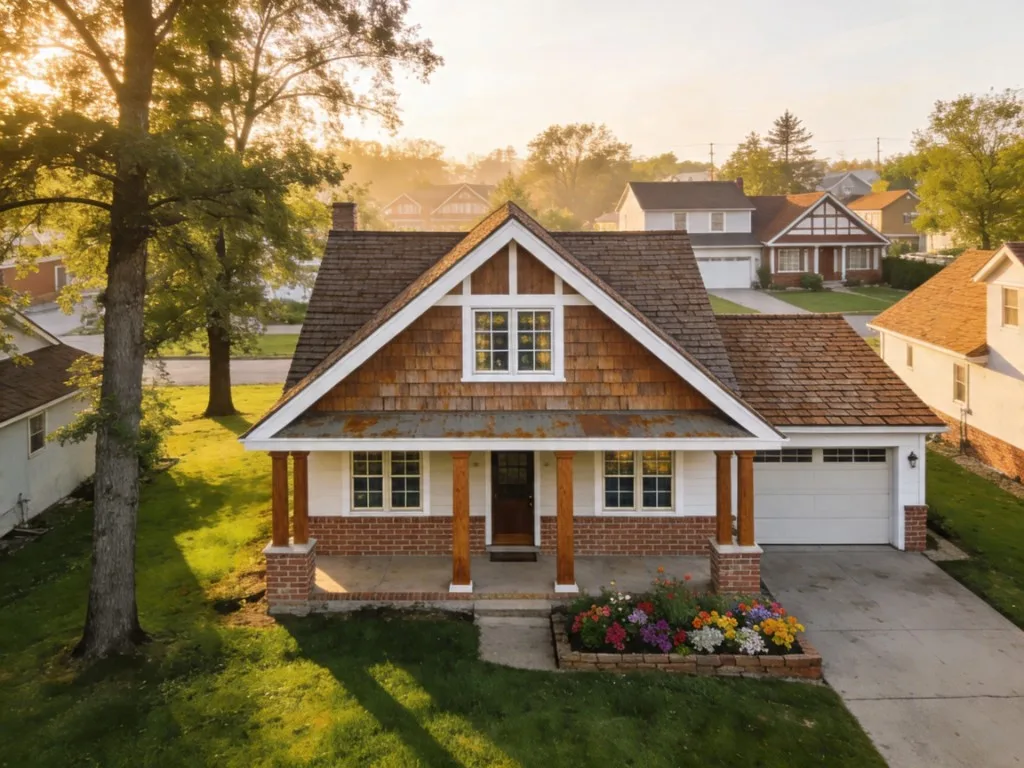
Most New York sellers who call us aren't in Manhattan. They've got a double in Buffalo's Black Rock with a tenant who's been there nine years, a parent's ranch in Greece or Irondequoit that's sat empty since spring, or a summons from the county clerk's office with a settlement conference date on it. This page covers how our offer works, what the market's doing this fall, and the state rules (foreclosure, probate, disclosure, transfer tax, tenant notice, and property tax) that decide how fast you can close. Every legal point links to the statute on the New York State Senate's site, so you can read it yourself.
How does selling to Home Pros work in New York?
Three steps. You can walk away at any of them.
1. Send the address
- Two minutes on the form, or one call
- Tell us what's wrong with the house, if anything
- No cleaning, staging, or photos
2. Read the written offer
- Delivered within 24 hours
- Shows the value, repair, and margin lines
- No appraisal contingency, since we pay cash
3. Close with the attorneys on your date
- As soon as 7 days, usually 14 to 30
- Your attorney and ours handle the contract and title
- We pay our side of closing
How do we calculate a New York cash offer?
One formula. You see every line of it.
We start from the after-repair value (ARV): what the house should sell for once it's updated and listed. Then we take out the repair cost, and then a margin that covers our holding time, both attorneys, title insurance, the resale, and the chance that the rehab runs long. What's left is the offer. Run your own numbers with the cash offer vs. listing calculator or read how we calculate offers line by line.
Here's our view on the statewide numbers: they're useless for an upstate house. A median that blends Westchester and Long Island with Cheektowaga tells you nothing about a 1920s double on Buffalo's West Side, so we use the city figure.
Illustration: a dated house at the Buffalo median
The median home value in Buffalo was $164,200 in the 2024 American Community Survey, per Data USA. Picture a three-bedroom that would sell near that once it's fixed, but it needs a tear-off roof, a boiler, and new electrical first: ARV about $164,200, minus roughly $30,000 of repairs, minus about $28,000 for margin, holding, and closing costs, leaves an offer near $106,200. That's an illustration, not a quote for any address.
Illustration: the same house needing only cosmetic work
If it only needs paint, carpet, and a cleanout: ARV about $164,200, minus around $8,000 of repairs, minus about $25,000 for margin, holding, and closing, leaves an offer near $131,200. A wet basement, a cracked block foundation, or knob-and-tube wiring moves the number down. We price those into the written offer up front instead of coming back after an inspection to renegotiate.
What is the New York housing market doing right now?
Asking prices are off their June peak, and listings are taking longer to sell.
New York's median listing price fell from $689,000 in June 2026 to $614,900 in October, while the median listing sat 60 days on the market in October, up from 50 days in June. Those come from Realtor.com data in FRED's median listing price and median days on market series for the state. Ten more days on market doesn't sound like much. It's another mortgage payment, another utility bill, and another month a buyer's inspector has to find the furnace.
Upstate is a different market from the statewide figure. The 2024 ACS numbers below put Buffalo, Rochester, and Syracuse home values at well under half the state median, and renters outnumber owners in all four cities. That's why so many of the houses we look at in Rochester's 19621 and Syracuse's Eastwood are rentals, often doubles with one side vacant. Investors already track these neighborhoods closely; our Buffalo off-market report shows what they pay attention to.
Should I take a cash offer or list with a New York agent?
A move-in ready house usually nets more on the market. Cash wins on speed, certainty, and condition.
Selling a house in New York: the rules
The laws that move your timeline or your net, each linked to the statute.
Closing: attorneys on both sides
New York is an attorney state in practice. The buyer's attorney usually drafts or reviews the contract, the seller's attorney reviews it and clears title objections, and the deal closes with both of them there, often with a title closer who records the deed. That's true even when the buyer pays cash. You'll want your own lawyer; we'd tell you that even if New York didn't.
What actually stalls a New York closing is the title report: an open estate, a judgment against a relative with the same name, or a mortgage that was paid off but never discharged. We order title the day the contract is signed so those problems show up in week one, not week six.
Foreclosure: a court case with three clocks
New York forecloses through the courts. Before a lender can sue on a home loan, RPAPL 1304 requires a notice mailed at least 90 days ahead, by registered or certified mail and first-class mail, with a list of at least five housing counseling agencies in your county. Once the case is filed, CPLR 3408 has the court hold a mandatory settlement conference within 60 days after proof of service is filed with the county clerk.
If the case ends in a judgment, RPAPL 1351 says the sale by the sheriff or a referee happens within 90 days of that judgment. Until a court orders you out, you can stay in the house, and until the auction you can sell it, pay off the loan at closing, and keep what's left. Our New York foreclosure timeline walks through each stage.
Probate: the $50,000 small estate limit doesn't cover the house
SCPA 1301 defines a small estate as personal property with a gross value of $50,000 or less. A house is real property, so the small estate route won't transfer it. In nearly every case, someone needs letters from the Surrogate's Court in the county where the owner lived (Erie, Monroe, Onondaga, Albany, and so on) before the house can be sold.
Once letters issue, the sale itself is fairly simple. EPTL 11-1.1 lets a fiduciary sell estate property at a public or private sale on terms the fiduciary thinks are best, unless the will left that house to a specific person. Our New York inherited house guide covers who inherits without a will, the creditor window, and estate tax.
Disclosure: a statement is due, but as-is is allowed
Under Real Property Law 462, a seller of residential property must deliver a property condition disclosure statement to the buyer before the buyer signs a binding contract. The form isn't a warranty. You answer from what you actually know, you can check "unknown," and the law doesn't make you inspect the house or search public records. The same section says plainly that the parties can still agree to sell "as is."
RPL 463 lists the transfers that don't need the statement at all, including sales by a fiduciary administering a decedent's estate, a guardianship, a conservatorship, or a trust, transfers under a foreclosure or a sheriff's sale, transfers between co-owners, and transfers under a divorce decree. A sale to an investor isn't on that list, so expect to fill the form out with us, honestly and briefly.
Transfer tax: $4 per $1,000, and the seller pays it
Tax Law 1402 taxes a conveyance worth more than $500 at $2 for each $500 of consideration, or fractional part, which works out to $4 per $1,000. Tax Law 1404 puts it on the grantor, meaning the seller, and the buyer only becomes liable if the seller doesn't pay. On a sale at Buffalo's $164,200 median, that's $658.
On a one, two, or three-family house, Tax Law 1402 also excludes the value of any lien that stays on the property after the transfer. In a normal sale the mortgage gets paid off at closing, so that rarely helps. Our offers show the transfer tax as its own line so you aren't surprised at the closing table.
Tenants: 30, 60, or 90 days' notice, depending on how long they've lived there
If you want a tenant out before you sell, Real Property Law 226-c sets the notice a landlord must give before ending or not renewing a tenancy: at least 30 days for someone who's been there less than a year, 60 days for one to two years, and 90 days for more than two years or a lease of two years or longer.
On a Buffalo double with a long-term tenant downstairs, that's three months of notice before you can even list it empty, and that's if the tenant actually leaves on time. Selling to an investor who keeps the tenant skips the whole exercise. We buy occupied upstate rentals as-is and take over the existing lease; read more in our guide to selling a rental with tenants.
Property taxes: school bills in September, county and town bills in January
New York doesn't have one statewide due date. The state Tax Department's property tax calendar says school tax bills go out at the beginning of September in most communities, and municipal and county bills at the beginning of January. Deadlines vary by school district and municipality, so the receiver of taxes in your town is the one to ask.
At closing, the attorneys prorate the taxes between buyer and seller and pay any arrears out of your proceeds. If you've fallen behind, you don't need to catch up before you sell to us; the payoff goes into the numbers. Upstate counties do take houses for unpaid taxes and sell them at auction, which our upstate tax foreclosure auction guide explains from the buyer's side.
What should a New York seller watch this quarter?
The January tax bill, and a vacant house through a lake-effect winter
Most upstate county and town tax bills land in early January. If you own a vacant or inherited house you don't plan to keep, that's the next big bill on the calendar, and every month you hold it also costs heat to keep the pipes from freezing, insurance that may not cover a vacant property, and snow removal your town expects you to handle.
The market's slowing into winter, too. Median days on market rose from 50 in June to 60 in October, and the median listing price is down about $74,000 from its June peak. A cash sale in November or December lets you close on a date you choose instead of waiting for the spring market. Our upstate winter selling guide runs the seasonal math, and owners thinking about a smaller place can read our New York downsizing guide for seniors.
Where do we buy houses in New York?
Upstate, from the Niagara Frontier to the Capital Region.
Western New York
- Buffalo (Erie County)
- Cheektowaga, Tonawanda, and Lackawanna
- Niagara Falls and Lockport
- Jamestown
Finger Lakes and Rochester
- Rochester (Monroe County)
- Greece, Irondequoit, and Gates
- Geneva and Canandaigua
- Batavia
Central New York
- Syracuse (Onondaga County)
- Utica and Rome
- Binghamton and Johnson City
- Auburn and Oswego
Capital Region
- Albany (Albany County)
- Schenectady and Troy
- Colonie
- Amsterdam
City pages for Buffalo, Rochester, Syracuse, Albany, Binghamton, Utica, Schenectady, and Niagara Falls are next in line. Until they're live, this page covers the whole state, and the offer process is the same wherever the house is. Every state we buy in is on the sell my house fast directory.
What situations do we buy houses in?
The house doesn't need to be in good shape, and the situation doesn't need to be simple.
Inherited property
We can sign with the executor or administrator once letters issue, and we'll wait on the Surrogate's Court if you're still in that stage. New York inheritance guide.
Foreclosure summons
New York's court process leaves time between the 90-day notice and the auction for a cash closing that pays off the loan. How a sale stops foreclosure.
Long-term tenants
Up to 90 days of notice under RPL 226-c, or you sell with the tenant in place. We do the second one all the time.
Divorce or separation
A fixed cash price and a date you both agree on keep the house from becoming one more thing to fight over. Divorce sale guide.
Code violations or major repairs
Open permits, a failed sewer lateral, ice-dam water damage, or a condemned porch get priced in. Nothing gets fixed first. Code violations guide.
Behind on property taxes
Unpaid school, town, or county taxes are paid out of the sale at closing, so you don't need cash on hand to sell.
Out-of-state owners
Plenty of upstate houses are owned by heirs in Florida or the Carolinas. The attorneys can handle signing by mail, so you don't have to fly in.
Every other problem
Fire damage, hoarding, mold, frozen pipes, and more. Browse every situation we buy in.
New York seller FAQ
How do I sell my house fast in New York?
Get a written cash offer from a direct buyer, sign a contract, and let the two attorneys run the closing. Home Pros sends a written offer within 24 hours and can close in as little as 7 days, though 14 to 30 days is typical. You skip repairs, showings, and commissions. The title search, not the buyer, usually sets the date.
How long does foreclosure take in New York?
It's a court process, so it's slow. Under RPAPL 1304 the lender must mail a 90-day notice before it can sue on a home loan. Once the case is filed, CPLR 3408 requires a settlement conference within 60 days after proof of service is filed with the county clerk, and RPAPL 1351 says the sale happens within 90 days of the judgment. You can sell and pay off the loan any time before the auction.
Can I use New York's small estate process to sell an inherited house?
Usually not. SCPA 1301 defines a small estate as personal property with a gross value of $50,000 or less. A house is real property, so it falls outside that procedure. An executor or administrator with letters from the Surrogate's Court can sell it, and EPTL 11-1.1 lets a fiduciary sell at a public or private sale unless the will gave the house to a specific person.
Do I have to fill out a disclosure statement if I sell my New York house as-is?
In most sales, yes. Real Property Law 462 says the seller must deliver a property condition disclosure statement before the buyer signs a binding contract, and the same section says the parties can still agree to an as-is sale. You can check "unknown" on questions you can't answer. RPL 463 exempts some transfers, including sales by a fiduciary administering an estate, foreclosure transfers, and transfers under a divorce decree.
Who pays the transfer tax when you sell a house in New York?
The seller. Tax Law 1404 makes the grantor responsible, and the buyer only owes it if the seller doesn't pay. Tax Law 1402 sets the rate at $2 for each $500 of the price, which is $4 per $1,000. On a $164,200 sale, the Buffalo median home value, that works out to $658.
When are property taxes due in upstate New York?
It depends on your town and school district. The state Tax Department says school tax bills go out at the beginning of September in most communities and municipal and county bills at the beginning of January, with deadlines that vary. At closing, the attorneys prorate taxes and pay any arrears out of your proceeds.
Can I sell a New York rental with the tenant still living there?
Yes, and it's often the easier path. If you'd rather end the tenancy first, Real Property Law 226-c requires 30 days' notice for a tenant there under a year, 60 days for one to two years, and 90 days for more than two years. We buy occupied rentals and take over the lease, so no notice is needed.
Which New York cities do you buy houses in?
We focus on upstate: Buffalo and Niagara Falls, Rochester, Syracuse, Utica, Binghamton, and the Capital Region around Albany and Schenectady, plus the towns in between. City pages are on the way. If yours isn't listed, send the address anyway.
How do you calculate my New York cash offer?
We estimate what the house sells for once it's fixed up, subtract the repairs, then subtract a margin for holding time, both attorneys, the transfer tax we cover, and resale risk. You get each number in writing, so you can check it against an agent's opinion.
Is Home Pros a legitimate company?
Yes. Home Pros is the trade name of Balint Holdings, LLC, a veteran-owned, BBB accredited company with a 4.9-star Google rating from 98 reviews. Every offer comes in writing, and you can read our BBB profile and Google reviews before you sign anything.
More New York resources
Guides, tools, and the people behind the offers.
Written by
Trevor Rice
Head of Acquisitions at Home Pros, and a licensed Texas real estate agent. Trevor oversees acquisitions across Home Pros' service states, including New York.
Updated November 15, 2026
Get a Fast Cash Offer in New York
Share a few details and we'll deliver a fair, no-obligation offer within 24 hours.
Have questions? Call (830) 510-1597.